blog > Mati Law
i looked in-to your eyes...i thought that i could-see a
whole-new-world!
- Olga Tokarczuk, The Empusium
There’s something that I’ve been trying to write about for a little while now. It’s related to transness, but apart from it as well, and I feel it when I’m experiencing a full body high in a club, when I’m bunched up like a spring at some function, and at most points in between.
It’s the physical, bodily feeling of being watched - of how others look at you, how you feel looking back at them (and how able to you feel), and how the uncertainty you feel in how they’re looking at you changes how you are, changes what they’re seeing, collapses your hyperposition.
I don’t know how common this is, but I don’t think I’ve ever experienced the gaze as something equal, something that I’m able to meet. Especially when I’m among strangers, being looked at carries this weight, feels like being pinned to a corkboard, for examination.
I can isolate this in a simple, common experience. You’re walking down a street, with nobody else around. You believe - you suppose - that you’re walking ‘normally’ - it’s strange to put it in those terms, really. You turn a corner and suddenly spot your opponent - guns at dawn - maybe sixty paces away. Where do you look? Do you know, reading this? Do you studiously ignore them? What if you get in their way? How are you walking? Those beads that you’re swinging in your hand, your komboloi, they were just a fiddle toy, but are they ~ performative ~ (to use the expression of the day). You walk with your hands in the pockets of your double breasted jacket - who do you think you are? Are they looking at you? Do you seem like a threat? Say this tableau is out somewhere more rural, Llambedr Pont Stefan. They might say hello to you! What will you say back? Do you alter your stride? Slow down? Speed up?
When I pass people on the street, I often stumble over my own feet. I’m so focused on projecting, that I forget how to walk.
Projecting… what exactly?
I’m entrusted with a very frustrating medical condition called esotropic strabismus - a lazy eye, or a squint, if you like. My left eye, through which I can see only the most abstract colours and shapes, turns inwards. How much? Who’s to say. I think substantially. But I don’t know what I look like, really. Nothing collapses things more than a camera. The camera makes me anxious, triggers my learned behaviours to minimise it, turn my head to one side, look sideways on - which carries its own connotations. A friend says that she can only get a good picture of me when I don’t know it’s being taken. And the person looking at me in the mirror isn’t the same person as in the photos. And people look different in motion than in photos anyway. And you filter your perception of someone through how you feel about them. Who’s to say.
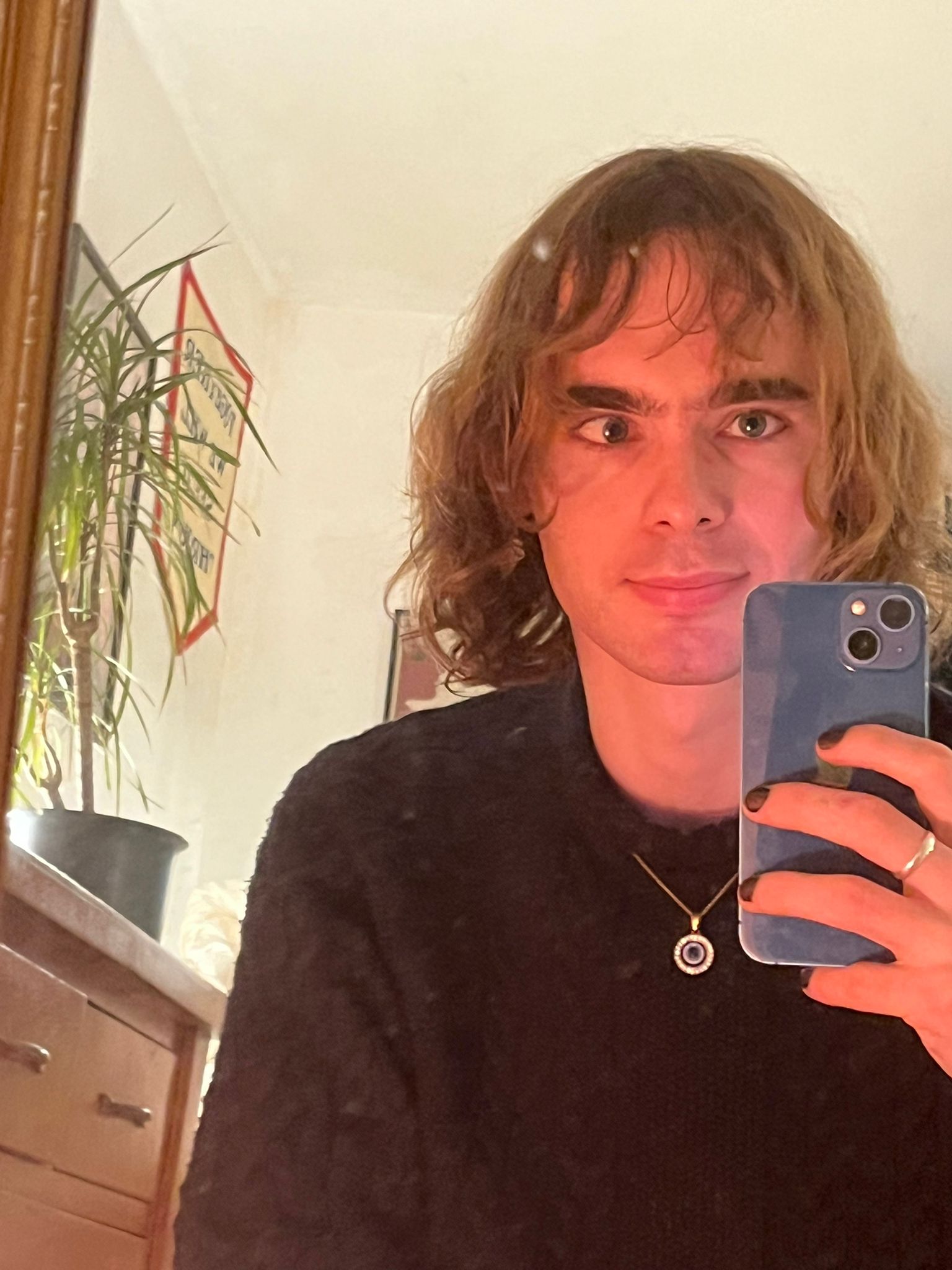
The point being, ‘eye contact’ isn’t quite as straightforward as all that. To me - for me - it works the same as it works for you. I see the world through one, unified portal - my right eye - perhaps with less depth perception - but my brain blocks the contradictory noise from its siamese twin, and I face the world dead on. But for you, you look at me and see one eye looking forwards, and one looking sideways. Your uncanny synapses fire. This changeling thing seems wrong. (Does it? Do you?). It moves like a person, but not quite. You see something moving below its skin. You stand to my side - a stranger, on a packed train car, jammed in together - and you do the thing that people do when they make eye contact (whatever that may be). You glance away, look back - and the eye remains staring at you. Unseeing, uncomprehending.
NEITHER CRY ALOUD NOR SHAKE CLENCHED FISTS AT THE GOD WHO IS TERRIBLE BUT PERFECT."
- Jenny Holzer, Inflammatory Essays
As a child, I loved the Hitchhikers Guide books. In a long aside, in the description of the uses of a towel, Adams says that it can be used 'to avoid the gaze of the ravenus bugblatter beast of traal (a mindbogglingly stupid animal, it assumes that if you can't see it, it can't see you)'.
As a trans person, it goes without saying that you experience a feeling of uneasiness when being looked at - dysphoria (if you like) can make you paranoid, feel like the wrongness you feel is obvious to everyone else as well. But the inverse is also true. Your awareness of your male apperance, that social role, can make you hyperaware of how you look at others. You know that your gaze - the ~male gaze~ - can impose on people. And people seem unsettled by your gaze. Don't they? If they do, why? Will they tell you? It would be impolite.
Your gaze - my gaze - when taken as standard, is Standard Default Male. You can't expect reciprocity - people who are rightly wary of this Standard Gaze will meet you side on, and peers will notice the deficiency before too long. When taken as substandard, or parastandard, invites paranoia. Why can't they look me in the eye? Is this invert sizing me up? Could it be contagious?
And you don't want to be seen anyway. Or rather, you feel like looking at others will be unwanted, unwelcome, and might draw unwanted attention, flip to the other side of the equation, and you don't want that either, do you? You're trapped, double blind. Seeing harms, and seeing invites being seen, which harms again. When the Other looks at you, you feel lacerated, humiliated, skewered. What you see isn't what I wanted to show you. I could show you so many things. But instead, when I walk around, I'm brandishing a loaded gun. Or two. Or three...
And so, you look anywhere but the face. Kiss anywhere but the mouth. Look only at yourself, how you imagine yourself to be. It's the closest thing to nonexistance you can get.
- John Berger, Ways of Seeing
Acting, as you have to, on this non standard output, from your non standard input, you create a model of the world-as-normal - the one implied through neutral sources, trusted friends, the mass of training data you consume, information that doesn't change when you look at it - and the self-as-abberation - the body and mind defined in the negative space, the gap between how a person would be to produce expected reaction, and the person you are to produce observed reactions. You're not sure exactly how far off the world-as-normal you are - maybe everyone suspects the same. Your models of both are faulty, imperfect, but you keep noticing a gap. It bugs you. Like a splinter in your mind, in your eye.
The idea of dysphoria is appealing to package up, a diagnosable medical condition. We've had the results back from the lab - it's dysphoria. You scored over 25 on amidysphoric.com. Congratulations! Were you born in the wrong body? Did you play with dolls as a child? Can we make a glossy, vaseline smeared flick about your school days? How your world as normal was dreamhouse, and your world as observed was mo-jo-do-jo?
But if you're not bound for Hollywood, it's a lot harder to unpick. All you have is this feeling, that 'people don't react to me the way that they should'. Why is that?
Is it because you came in, wide eyed and overparented, midway through the school year? Because you were a newcomer wherever you went? Or because you shaved your legs, which went unnoticed for weeks, in any case, you think. But children know who the fags are quicker than the fags do. Is it because there's a deficiency written on my face, visible to everyone except me, meaning I can't look at you straight? If so, which one? Some I know about, can see on pictures, even if I can't quite work it into my view of myself. Others, I might not know at all? And do they compound? Trans people often have ADHD, autism, we call it 'comorbid'. Proof of social contagion - if you believe that kind of thing. Is it not more likely that this feeling of wrongness has to get to a certain point - a critical mass - gender on top of social on top of exclusion - before you even start to think about transition?
- Olga Tokarczuk, The Empusium
As scary as it was to come out, and as much as it's still a work in progress, I feel much more real since doing it. The gaze of others has this regulating quality - and there's nothing inherently wrong with that. Noone is an island, and we care about what our loved ones think of us, because we care about them, and we want to be the best for them.
The gaze is negating when it's only one way. You don't know how you're seen, not really. If you can't meet another's eyes, you're trapped inside them, twisting yourself to fit what you think they see to what you think they expect to see.
Transition isn't uncovering a core, 'true' essence - or at least, I don't find that a useful story to tell myself. Rather, it's a conscious, defined decision about how you want to be seen, one that's taken with evidence about how you've not wanted to be seen before, the epistemic framework of transition, and faith that it's the right thing for you. A total decision, a reinvention, on your terms. How many of those do you get the opportunity to make, these days? You can't skip town any longer.
And now, having chosen, you can meet the eyes of others, knowing what you intend to projecting, despite its inevitable distortion, rather than prefiguiring both what they want and what they'll get. And if you can meet their eyes, even obliquely, then you can withstand disgust or rejection - you stand on solid enough ground to pass judgement yourself. No matter what, I see you as you see me. I act on you, as you act on me.
-Umberto Eco, Foucalt's Pendulum